
 English
 Albanian
 Arabic
 Bosnian
 Bulgarian
 Croatian
 Czech
Czech Danish
 Dutch
Dutch Estonian
 Finnish
 French
 Georgian
 German
 Greek
Greek Hungarian
 Icelandic
 Italian
 Latvian
 Lithuanian
 Macedonian
 Maltese
 Norwegian
 Polish
 Portuguese
 Romanian
 Russian
 Serbian
 Slovak
 Slovenian
 Spanish
 Swedish
 Turkish
 Ukrainian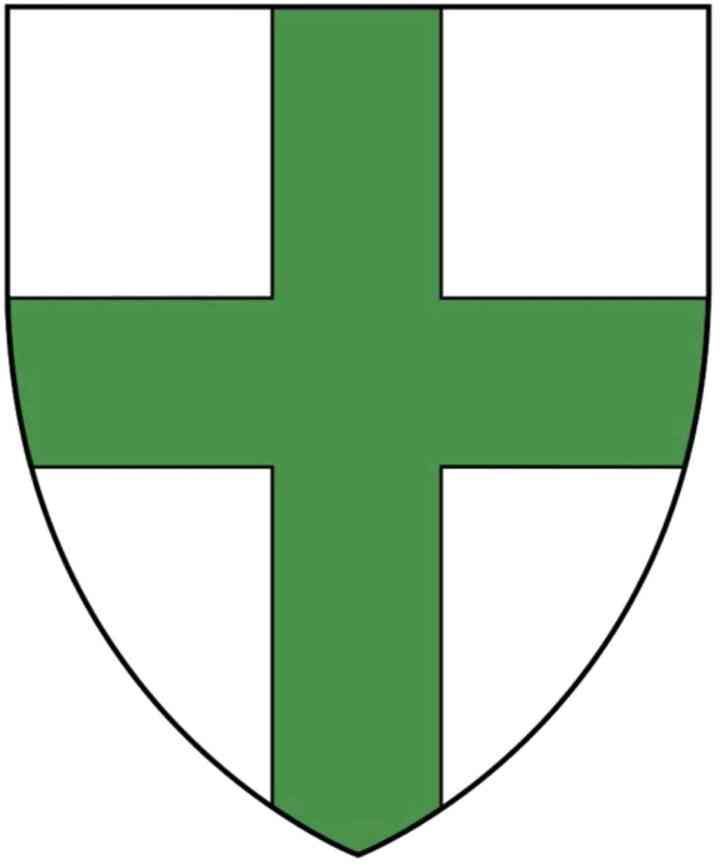
confraternal order of saint lazarus of jerusalem
(bratstvo svätého lazara z jeruzalema)

Kings who recognized the Order of Saint Lazarus before
it was “canonically recognized” by Pope Alexander IV in 1255.
The Order of Saint Lazarus of Jerusalem was recognized and supported by several key medieval monarchs who granted it legitimacy, land, and royal protection.
King Fulk of Jerusalem (1142): The earliest formal royal recognition of the order came in 1142, when King Fulk officially recognized and granted protection to the Lazarite hospitals in the Holy Land.
King Louis VII of France (1154): Upon returning from the Second Crusade, King Louis VII officially recognized the Order’s presence in France by granting them the Château de Boigny near Orléans, which became their western headquarters.
King Amalric of Jerusalem (1162–1174): King Fulk’s successor, Amalric, became a strong supporter of the order. This was significantly aided by the fact that his son, the famous “Leper King” Baldwin IV, suffered from leprosy and was closely associated with the Lazarite brothers.
King Henry II of England (1159): In a surviving letter from 1159, Henry II made a large donation to the order and formally referred to them as the “knights and brothers of Saint Lazarus,” proving early English royal recognition.
King Andrew II of Hungary was known for his close tie to the Order of Saint Lazarus. During his crusade to the Holy Land in 1217–1218, he became a devoted supporter of the crusading orders. After the Templars, the Order of the Knights Hospitaller is historically the most famous crusading order, but Andrew II also supported the Order of Saint Lazarus. His close relationship with these knightly brotherhoods was such that frescoes in Malta and at the Palace of Versailles in Paris depict the king receiving the cross and habit as the first crowned monarch to join the crusading orders. I consider it very important to remember the Battle of Rozhanovce – June 15, 1312, but especially its consequences for Hungary and the Eastern Orthodox Church.
King Louis IX of France (The Saint): Played an important role in the history of the Order of St. Lazarus after the Seventh Crusade. In 1253, he granted the order a significant royal decree of protection. This decision allowed them to establish their main headquarters in Europe (Paris) and later build an extensive network of lazarettes and hospitals.
Papal recognition of the Order of Saint Lazarus as a religious and military order came from Pope Alexander IV in 1255.
On April 11, 1255, he issued the papal bull Cum a nobis petitur, which formally confirmed the existence of the Order under the Rule of Saint Augustine and placed the order under the protection of the Holy See.
The historical intersection of Eastern Orthodoxy and the early Order of Saint Lazarus is a fascinating chapter of crusader history. However, it is important to separate the historical composition of the order from the reality of Catholic canon law.
Although Eastern Christians played a massive role in the daily functioning of the order, they did not form a legally independent body under Catholic canon law during the Crusades.
1. The Influence of the Orthodox Church in the Holy Land
The original hospital of the Order of Saint Lazarus operated long before the First Crusade and was heavily influenced by Orthodox monasticism and Eastern traditions regarding the care of lepers.
When the Latin (Catholic) crusaders captured Jerusalem on July 15, 1099, they integrated the hospitals of the Eastern Orthodox Church into their network. Since leprosy does not discriminate by denomination, the order’s hospitals continuously cared for a vast number of local Eastern Orthodox Christians, Syrian Christians, and Melkites.
2. Legal Status under Roman Catholic Canon Law
Despite the fact that the order cared predominantly for an Eastern population and the staff of other orders, the formal institution known as the Order of Saint Lazarus was legally established as a Latin (Roman Catholic) religious order from 1255 onward.
a) Papal Recognition: The order gained recognition under Catholic canon law through the papal bull Cum a nobis petitur from Pope Alexander IV in 1255.
b) Rule: From its inception until 1255, the order operated under the Eastern Orthodox Rule of Saint Basil. After 1255, the order operated under the Catholic Rule of Saint Augustine.
c) Legal Reality: Under the strict parameters of medieval Catholic canon law, the order answered directly to the Pope and the Latin Patriarch of Jerusalem. At that time, the Patriarch was not recognized as a separate, autonomous Eastern Orthodox jurisdiction.
3. Complications of the Schism of 1054
The Great Schism of 1054 legally separated the Roman Catholic Church from the Eastern Orthodox Church. Since the Crusader states were under Latin Catholic administration after 1255, any military or religious order approved by the Pope had to remain officially Catholic at its executive level. Local Orthodox Christians could serve in the hospitals, work as doctors, and receive care, but they did not have the sovereign canonical authority to alter the legal framework of the order.
4. Modern Shift: The Melkite Connection
The historical argument regarding Eastern Christianity and the Order of Saint Lazarus became highly relevant again in the 19th and 20th centuries, which is likely where this specific canonical defense originates.
When the order lost its French royal protection in 1830, its representatives turned to the East to preserve their heritage.
a) The Slippery Slope to the French Throne: In the 1840s, “The Military and Hospitaller Order of Saint Lazarus of Jerusalem” (an initiative of the Spanish Bourbons) requested spiritual protection from the Melkite Greek Catholic Patriarch of Antioch and received it.
b) The Melkites are an Eastern Catholic Church – meaning they practice Byzantine (Eastern) rites but remain in full communion with the Pope in Rome.
By aligning themselves with the Melkite Patriarch, modern defenders of the Military and Hospitaller Order of Saint Lazarus of Jerusalem argue that the order maintained an intact, independent canonical existence through the Eastern Church when it was ignored by the Western Roman Catholic Church.
Summary: While the daily reality of the medieval order was deeply ecumenical and relied heavily on Eastern Orthodox participants, the reality of canon law is that the medieval institution was firmly a Latin Catholic entity. The idea of the order utilizing an Eastern identity to gain an independent legal status is a modern structural development rather than a medieval one.
Note: The 13th-century papal bulls that defined the Catholic legal status of the order, and how the Melkite Patriarchate justifies its role as protector of the modern order today.
5. Orthodox Bishops and Confraternities
In the West, if laypeople wanted to create a religious group or a knightly order, they needed top-down permission from a king or a papal bull. In the Eastern Orthodox world, the legal paradigm is completely inverted, relying on bottom-up action and local episcopal blessing.
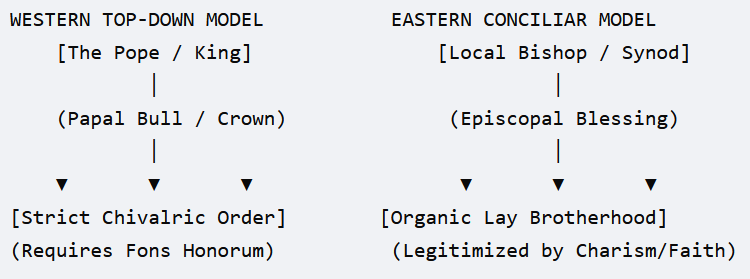
a) Legal Sovereignty from Below: Historically, in times of crisis (such as the Polish-Lithuanian occupation of Ukraine and Belarus), Orthodox laypeople realized they could not rely on royal crowns to protect their faith and began establishing Confraternities (lay religious brotherhoods).
b) Source of Authority: Legal and spiritual status was granted to a Confraternity not by a secular king, but directly by the local ruling bishop or episcopal synod through an episcopal blessing.
c) Independence from the State: These confraternities established schools, printed books, funded hospitals, and managed charity. They were considered fully legitimate expressions of the Church. To the Orthodox mind, the Church is the ultimate authority; it does not need a secular prince (fons honorum) to validate its services.
6. Grand Priory of Carpathia – Confraternal Order of Saint Lazarus of Jerusalem
When the Grand Priory of Carpathia operates as an Orthodox confraternity, it acts precisely within this historical tradition. Its legitimacy is based on eucharistic communion and episcopal oversight, rather than on a charter from a specific European royal family or the Pope.
7. How This Tension Was Experienced by Other Crusading Orders
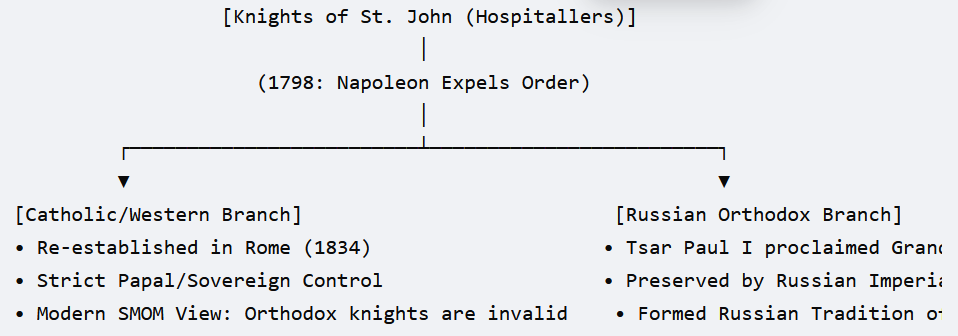
The Order of Saint Lazarus is not the only crusader entity to fall victim to the clash between Western legalism and Eastern reality. The same split also occurred within the Order of Saint John (Knights Hospitaller / Knights of Malta).
8. The Tsar as Grand Master of the Knights of Malta (1798)
When Napoleon captured Malta in 1798, the Knights of Malta fled the island. In a desperate desire for protection, the majority of the knights fled to St. Petersburg and proclaimed Tsar Paul I of Russia (an Eastern Orthodox Emperor) as their Grand Master.
a) The Orthodox Perspective: The Russian Crown accepted the Order organically, protecting the mission of the Knights Hospitaller and establishing an Orthodox lineage of the Knights of Malta.
b) The Catholic/Academic Perspective: The mainstream of Catholic phalerists and the modern Sovereign Military Order of Malta (SMOM) look back at this history and declare Tsar Paul I’s Grand Mastership to be completely invalid. Why? Because the Pope never officially signed off on a Catholic order being led by an Orthodox emperor.
Just as in the case of Saint Lazarus, Western Catholic academia prioritizes a strict canonical signature from Rome over the historical, organic reality of Eastern Christian protection.
The Wording of the 2012 Vatican Declaration Regarding “Unrecognized Orders”
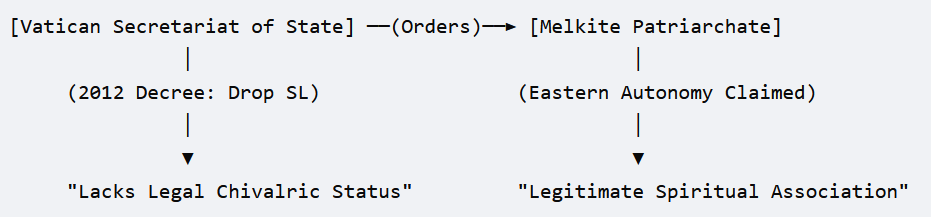
The formal 2012 Vatican declaration regarding unrecognized knightly orders was issued by the Vatican Secretariat of State on October 16, 2012. It was published worldwide to curb the proliferation of private, revived, or self-proclaimed knightly organizations using the names of medieval entities.
The official explanation from the Secretariat of State reads as follows:
The official declaration of the Secretariat of State clarifies that the Holy See recognizes only its own knightly orders. It explicitly states that all other orders, whether ancient or modern, are not recognized, and the Vatican does not endorse their legitimacy, structure, or credentials.
The declaration further states that no value is attributed to certificates or insignia from unrecognized groups, and it is recommended that premises in Roman Catholic churches or chapels not be used for their ceremonies.
Key Takeaways
a) Exclusivity of Recognition: The Vatican explicitly limits recognized orders to specific ones, grouping a small list of all other orders—including various branches of the Military and Hospitaller Order of Saint Lazarus of Jerusalem—as unofficial, regardless of their claims or historical past.
b) Restriction on Use: The directive prohibits the use of Catholic sacred spaces for the events of these unrecognized organizations.
c) No Historical Endorsement: The declaration denies any 20th-century Vatican “historical or legal legitimacy” to such groups.
Emphasizing a strict, top-down legal system, this 2012 document declares that the Vatican “attributes no value” to the titles or insignia of non-papal knightly organizations, ignoring their independent activities or historical claims.
An examination of how the Melkite Patriarchs reacted to these strict Vatican restrictions given their role as protectors of the order since 1910, and how Eastern Orthodox bishops bypass this decree entirely within their own sovereign dioceses.
The 2012 Vatican declaration created a serious diplomatic and canonical dilemma. By enforcing a strict, top-down Roman Catholic legal standard, Rome came into direct collision with both the Melkite Greek Catholic Patriarchate (which sought to bridge East and West) and independent Eastern Orthodox bishops.
Here are the facts on how both of these East-oriented factions reacted to and bypassed the strict Vatican restriction.
9. How the Melkite Patriarchs Reacted
The Melkite Greek Catholic Church says it is a unique bridge: it is fully Catholic and in communion with Rome, but it retains its distinct Byzantine-Eastern liturgical, theological, and canon law traditions. Since 1841 (and consolidated by reorganization in Paris in 1910), Melkite Patriarchs have served as spiritual protectors of the Military and Hospitaller Order of Saint Lazarus of Jerusalem.
When the Vatican issued its strict declarations, the Melkite Patriarchs faced immense pressure from the Roman Curia to cease protecting the Military and Hospitaler Order of Saint Lazarus of Jerusalem. Their reaction was a masterclass in Eastern ecclesiastical diplomacy:
- The “Spiritual Protection” Loophole: The Patriarchs adhered to the letter of Roman law but bypassed its spirit. They acknowledged that under Roman phaleristic law, the Military and Hospitaller Order of Saint Lazarus of Jerusalem might not be recognized by the Vatican as a sovereign state knightly order. However, they argued that as an Eastern Patriarch, they have an absolute right to grant spiritual protection to any international association of Christian faithful.
- Refusal to Abandon the Charism: Patriarch Gregory III Laham (who reigned during the 2012 decree) actively maintained his relationship with the Military and Hospitaller Order of Saint Lazarus of Jerusalem. He argued that the Order’s massive humanitarian funding for hospitals, leper colonies, and clinics in the war-torn Middle East was a vital tool for Christian survival in the region.
- The Final Compromise (2012–2016): Under intense pressure from the Vatican Secretariat of State, the Melkite Patriarchate eventually modified its formal title from “Protector” to “Spiritual Protector” and later shifted to providing spiritual support primarily on an individual episcopal basis. They complied just enough to avoid a formal schism with Rome, while privately assuring that their Military and Hospitaller Order of Saint Lazarus of Jerusalem spiritual lineage remained intact.
10. Orthodox Bishops and the Decree
While the Melkite Patriarchs had to play a delicate diplomatic game with Rome, Eastern Orthodox bishops face no such restrictions. For an Orthodox jurisdiction—such as the bishops overseeing the Grand Priory of Carpathia—the 2012 Vatican declaration carries absolutely zero canonical or legal weight.
Orthodox bishops can completely ignore the Roman decree by utilizing two fundamental pillars of Orthodox ecclesiology:
11. Sovereignty of the Local Bishop (Episcopalis Jurisdictio)
In Orthodox canon law, every diocesan bishop is completely sovereign within his own territory. There is no equivalent of a “Pope” or a centralized “Secretariat of State” in Rome that can dictate what happens inside an Orthodox cathedral.
If an Orthodox bishop or metropolitan decides to bless the Grand Priory of Carpathia and hold a vigil in his church, or permit them to use their insignia, the Vatican has no authority to stop it.
The Vatican rule stating that “sacred spaces cannot be used” applies exclusively to Roman Catholic churches, leaving Orthodox holy spaces entirely open to the confraternity. Why?
12. Redefining the Mandate: From “Chivalry” to a “Diaconal Order”
Orthodox bishops can completely bypass the debate over “fons honorum” by changing the theological vocabulary, rather than viewing the Grand Priory of Carpathia through the lens of medieval European court etiquette.
To an Orthodox bishop, the jurisdiction of the Grand Priory of Carpathia is to be perceived as a Diakonia (service) and an Ecumenical Confraternity.
When a bishop blesses our work, he blesses our prayers, our fundraising efforts, and our physical care for the marginalized.
By ignoring the Roman definition of an “order,” it renders the Vatican’s 2012 critique completely irrelevant to our services.
“We are not going somewhere—we are returning home.“
Col. Andrew T. Adam von Rhedey, Grand Prior of the Grand Priory of Carpathia
Confraternal Order of Saint Lazarus of Jerusalem
13. The Greatest Irony
This clash reveals a profound historical irony: Rome’s attempt to delegitimize the Order of Saint Lazarus through the 2012 decree actually brought parts of the Order closer to its original Eastern roots.
By closing the doors of the Western Roman Catholic Church, the decree forced jurisdictions like the Grand Priory of Carpathia to take root deeply within the soil of the Eastern Orthodox Church—the exact theological atmosphere where the original Lazarites and Hospitallers were born a thousand years ago in Jerusalem.
14. Where should we head from here to connect this historical journey?
We can look at the precise theological differences between how the Eastern Orthodox Church and Western Catholicism perceive the very concept of “chivalry.
15. The Truth Shall Set Us Free
This timeless phrase perfectly captures the core of our entire history. When we look past modern legal disputes over crowns and signatures, we find the real truth: the true legacy of Saint Lazarus is found in service, not in “fons honorum.”
It is my pleasure to present these fascinating historical and theological connections to you, particularly how the Schism of 1054 still resonates in modern debates, bringing incredible clarity to these topics.
From a historical perspective, the Grand Priory of Carpathia of the Confraternal Order of Saint Lazarus of Jerusalem is a respected chivalric and hospitaller institution. The roots of the Lazarite brothers undoubtedly stretch back before the 13th century in the Holy Land, where caring for lepers was their well-known original mission. To this day, the Grand Priory of Carpathia of the Confraternal Order of Saint Lazarus of Jerusalem maintains the traditions of humanitarian aid and chivalry, while also champion the meaning of Christian charity to our youth.

Colonel Andrew T. Adam von Rhedey
GRAND PRIOR – GRAND PRIORY OF CARPATHIA
CONFRATERNAL ORDER OF SAINT LAZARUS OF JERUSALEM